# Benchmarks for the H48 optimal solver and comparison with vcube
This page contains some benchmarks for some of the possible
configurations of the H48 optimal solver. For comparison we also
include similar measurements for Andrew Skalski's impressive optimal
solver [vcube](https://github.com/Voltara/vcube), which has been taken
as a benchmark reference throughout the development of H48. The two
solvers differ both in method (although they both use an A* search)
and implementation.
Similar benchmarks can be found:
* In Chen Shuang's
[dedicated github page](https://github.com/cs0x7f/cube_solver_test/wiki),
which includes many more solvers. At the time of writing, the version
of H48 used for these benchmarks is a rather old one. Note that
cube48opt is a re-implementation of the H48 solver by Chen Shuang.
* In Enrico Tenuti's [thesis](https://github.com/enricotenuti/h48thesis),
also using an old implementation of H48, but including more data and
nice plots.
## Setting
*All movecounts are in Half Turn Metric*
For the benchmarks we used some sets of random positions that can be found
in `benchmarks/scrambles`. We divide them by optimal solution length,
because the time to solve a scramble grows exponentially on the number of
moves, so mixing up positions with long and short solutions is going to
make the shorter solution almost irrelevant. Even within the same solution
length the time to solve a random position can vary significantly,
so we have used sets of 25 scrambles and taken the average of those,
except for the [Superflip](https://en.wikipedia.org/wiki/Superflip),
which is a single scramble.
For short solutions, the very low numbers we get with the largest solver
may be particularly inaccurate, because writing the solution (together
with some log messages) to standard output may take a significant portion
of the time, depending on the terminal emulator used and other factors.
All benchmark tests were done on the following configuration:
* CPU: AMD Ryzen 7 7700 (8 cores, 16 virtual threads)
* Memory: 2x Corsair Vengeance 32GB 5600MHz
* Motherboard: Gigabyte B650M K
* Operating system: Debian 13 (Linux kernel 6.12.57)
* Compiler: GCC 14.2.0 for H48 and Clang 19.1.7 for vcube
## Benchmark results
### Single solution, single thread
The first test we performed was finding a single optimal solution, and
we compared the results with vcube.
This test was run in a single-thread configuration, because the two
solvers use very different strategies for multithreading: vcube can only
parallelize by solving one cube per thread, while H48 is able to take
advantage of multiple threads even when solving a single cube. Therefore
we prefer to compare their single-threaded performance only.
Since the size of the pruning table used by the solver is of utmost
importance, we include two statistics: time per cube and time per cube
*adjusted by table size*. The adjustment we took simply consists in
multiplying the time per cube by the size of the table. Empirically this
leads to more even results across the board, although the speed of the
solvers of the same family does not scale exactly linearly with the size
of the pruning table.
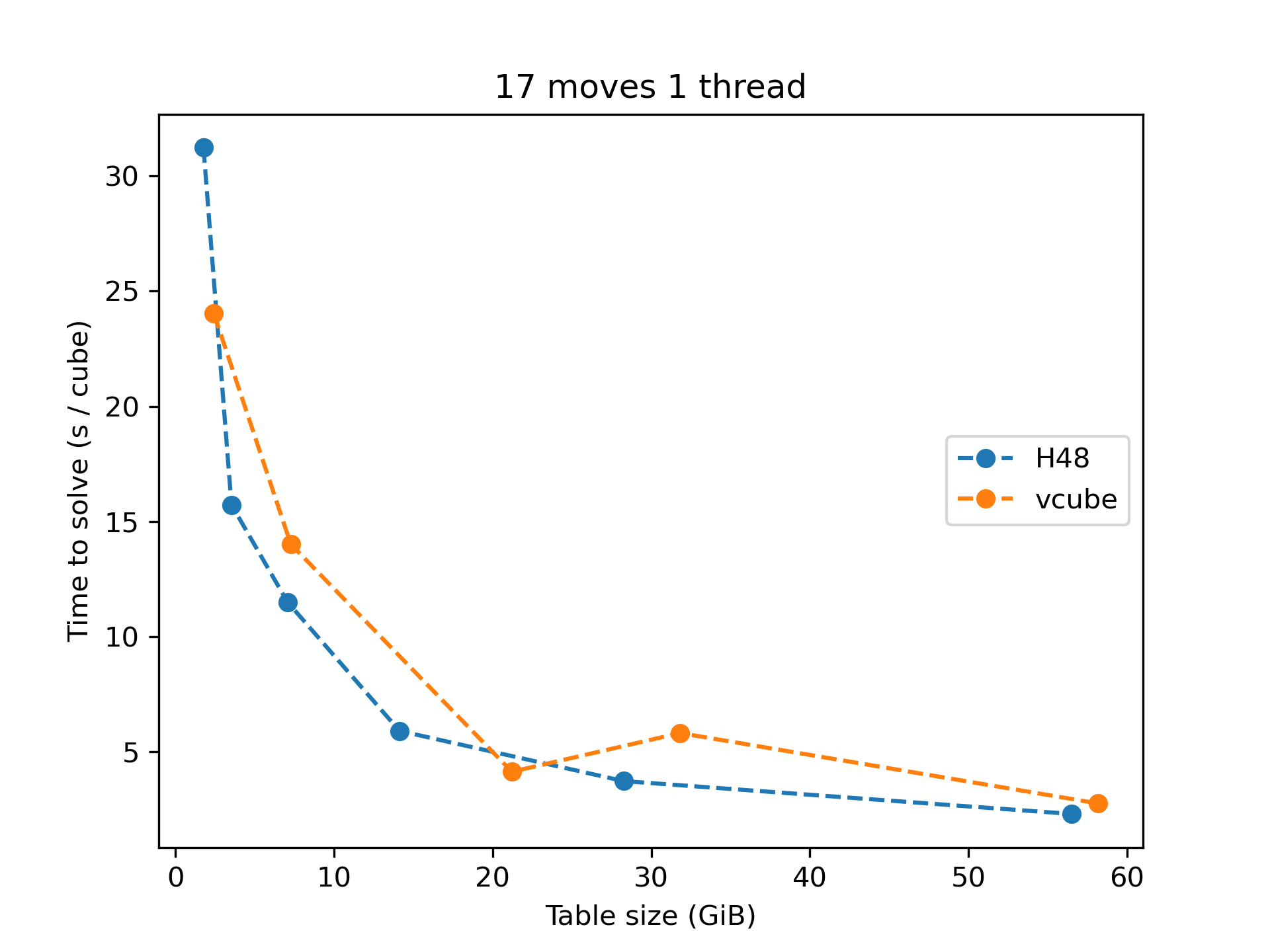
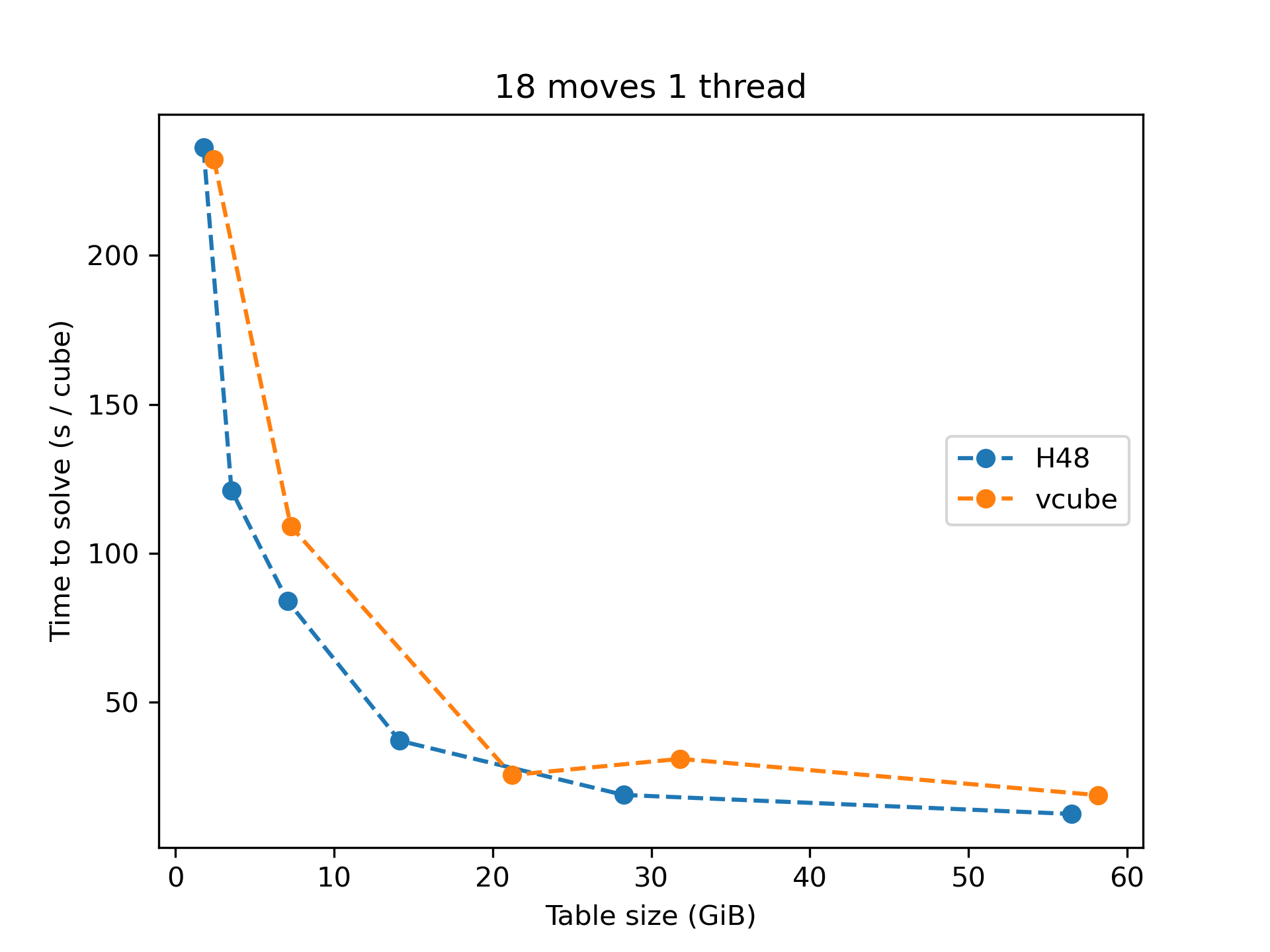
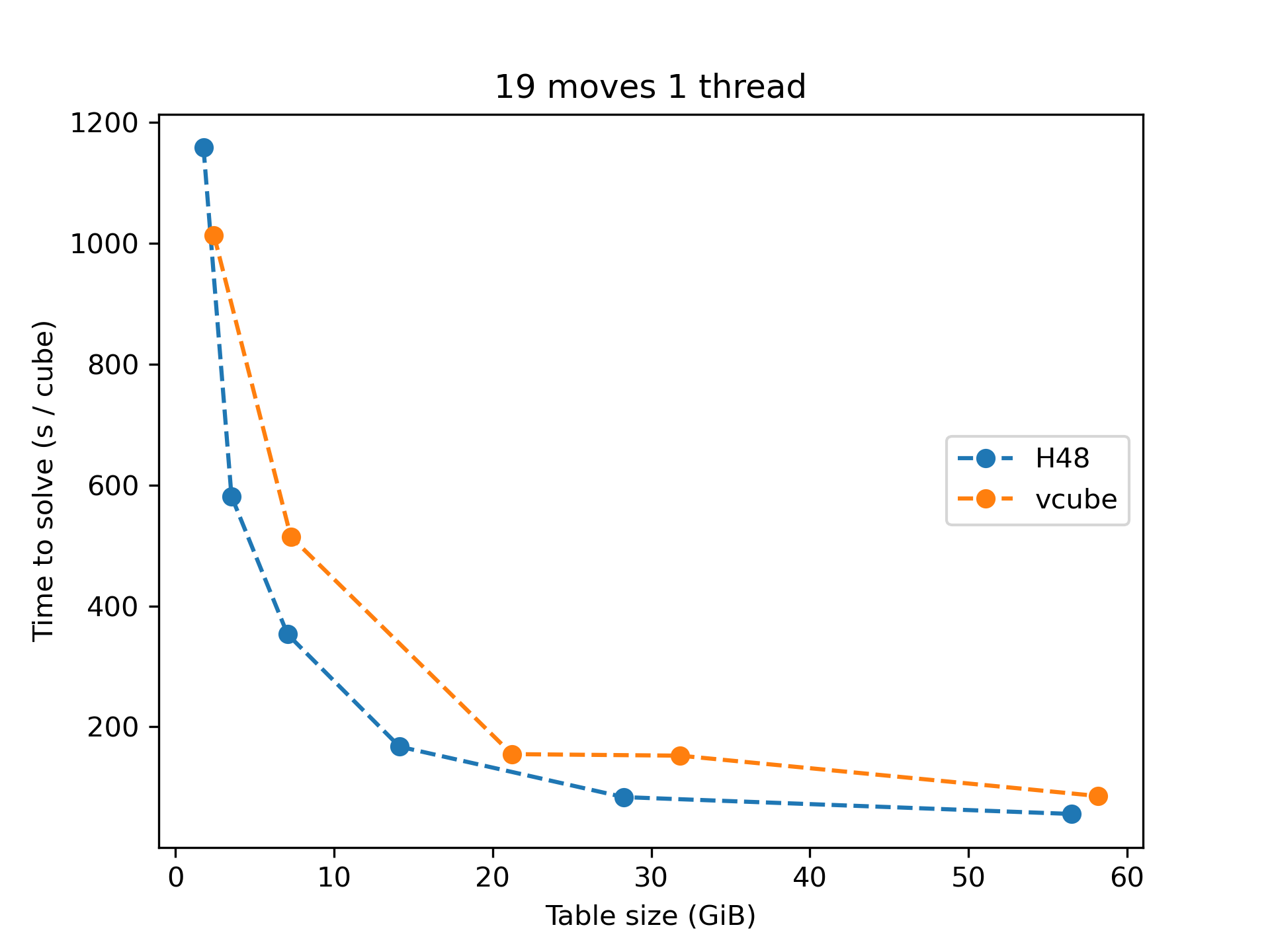
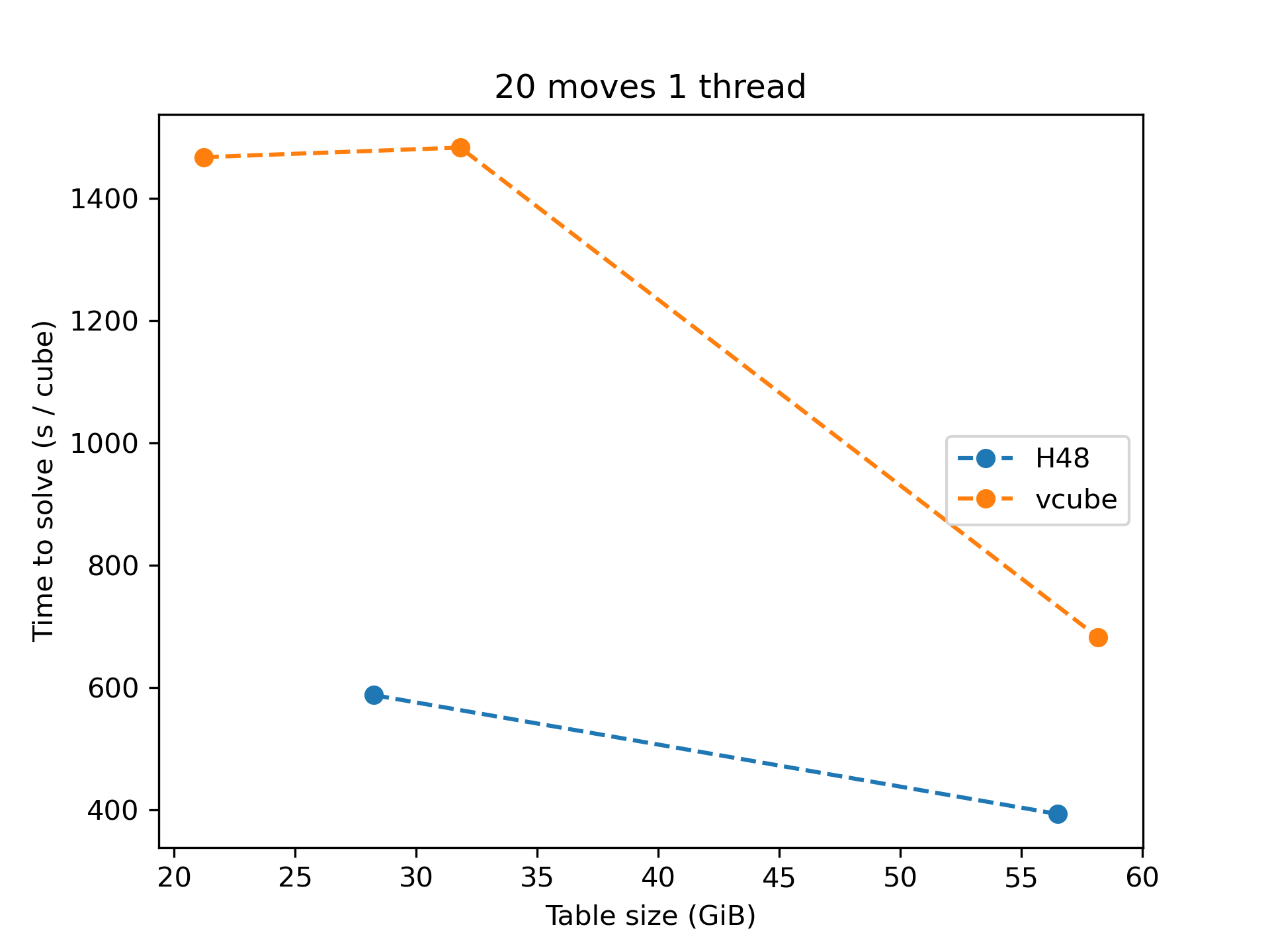
Results: Single solution, single thread
Time per cube (in seconds, lower is better).
| Solver | Size |17 moves|18 moves|19 moves|20 moves|Superflip|
|:---------|:-------|-------:|-------:|-------:|-------:|--------:|
|vcube 212 |58.2 GiB| 0.11| 0.75| 3.43| 27.28| 19.30|
|H48 h11 |56.5 GiB| 0.09| 0.50| 2.24| 15.73| 15.55|
|vcube 404 |31.8 GiB| 0.23| 1.24| 6.10| 59.33| 268.26|
|H48 h10 |28.3 GiB| 0.15| 0.76| 3.36| 23.51| 38.05|
|vcube 308 |21.2 GiB| 0.17| 1.02| 6.20| 58.70| 604.35|
|H48 h9 |14.1 GiB| 0.24| 1.48| 6.69| | |
|vcube 208 | 7.3 GiB| 0.56| 4.36| 20.58| | |
|H48 h8 | 7.1 GiB| 0.46| 3.36| 14.13| | |
|H48 h7 | 3.5 GiB| 0.63| 4.85| 23.25| | |
|vcube 112 | 2.4 GiB| 0.96| 9.29| 40.52| | |
|H48 h6 | 1.8 GiB| 1.25| 9.45| 46.31| | |
Time per cube adjusted for table size (in seconds \* GiB, lower is better).
| Solver | Size |17 moves|18 moves|19 moves|20 moves|Superflip|
|:---------|:-------|-------:|-------:|-------:|-------:|--------:|
|vcube 212 |58.2 GiB| 6.43| 43.80| 199.38| 1587.43| 1122.73|
|H48 h11 |56.5 GiB| 5.21| 28.28| 126.68| 889.01| 878.77|
|vcube 404 |31.8 GiB| 7.40| 39.47| 194.01| 1887.94| 8535.87|
|H48 h10 |28.3 GiB| 4.22| 21.37| 94.86| 664.22| 1075.08|
|vcube 308 |21.2 GiB| 3.51| 21.71| 131.50| 1245.26| 12819.94|
|H48 h9 |14.1 GiB| 3.34| 20.97| 94.57| | |
|vcube 208 | 7.3 GiB| 4.08| 31.74| 149.68| | |
|H48 h8 | 7.1 GiB| 3.25| 23.75| 99.82| | |
|H48 h7 | 3.5 GiB| 2.22| 17.12| 82.14| | |
|vcube 112 | 2.4 GiB| 2.33| 22.53| 98.23| | |
|H48 h6 | 1.8 GiB| 2.21| 16.70| 81.86| | |
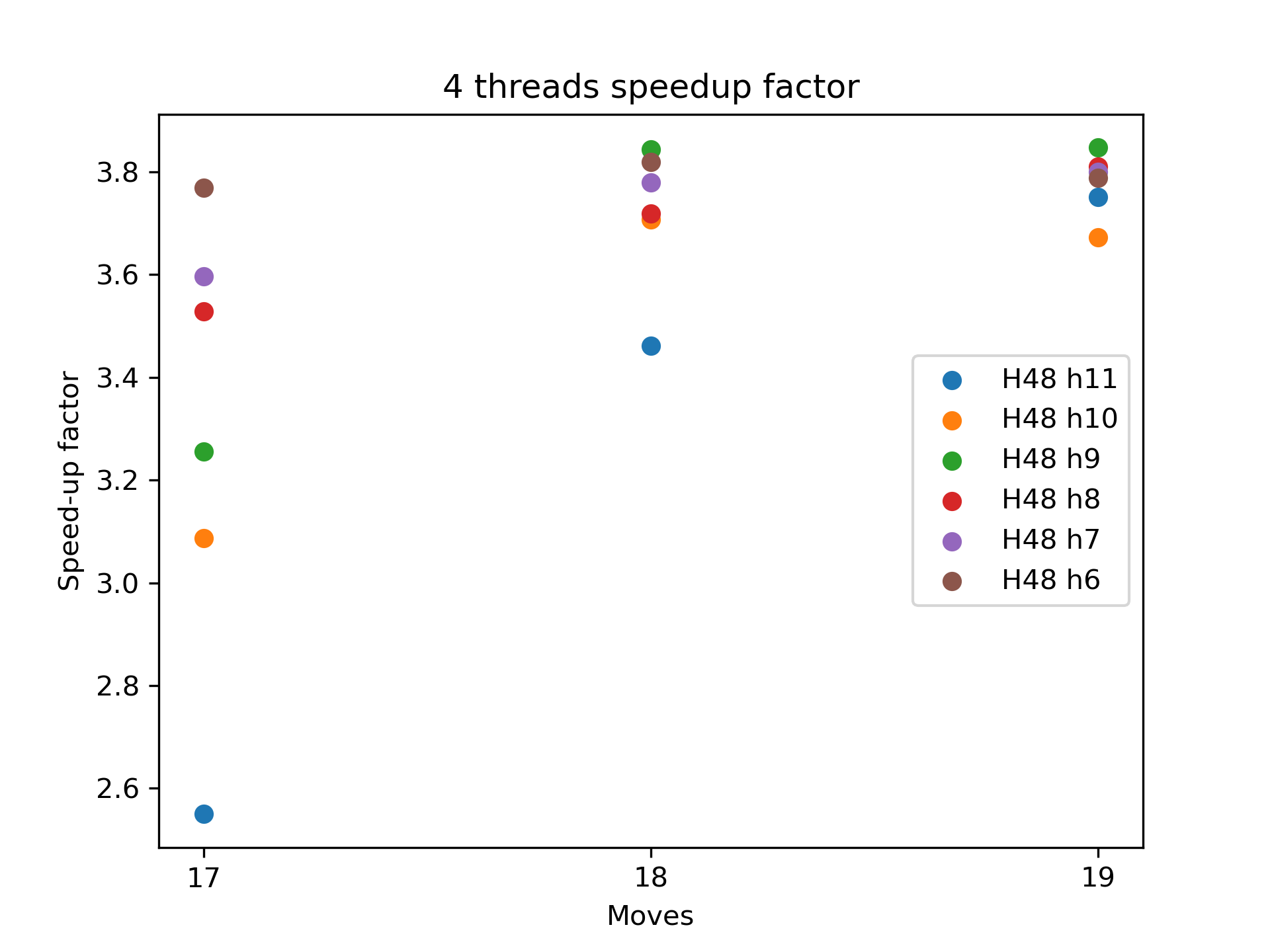
Results: Single solution, 4 threads
Time per cube (in seconds, lower is better).
| Solver | Size |17 moves|18 moves|19 moves|20 moves|Superflip|
|:---------|:-------|-------:|-------:|-------:|-------:|--------:|
|H48 h11 |56.5 GiB| 0.04| 0.14| 0.60| 3.97| 4.19|
|H48 h10 |28.3 GiB| 0.05| 0.20| 0.91| 6.65| 9.81|
|H48 h9 |14.1 GiB| 0.07| 0.39| 1.74| 12.54| 18.96|
|H48 h8 | 7.1 GiB| 0.13| 0.90| 3.71| | |
|H48 h7 | 3.5 GiB| 0.17| 1.28| 6.12| | |
|H48 h6 | 1.8 GiB| 0.33| 2.47| 12.22| | |
Speed-up factor (higher is better).
| Solver | Size |17 moves|18 moves|19 moves|20 moves|Superflip|
|:---------|:-------|-------:|-------:|-------:|-------:|--------:|
|H48 h11 |56.5 GiB| 2.55| 3.46| 3.75| 3.96| 3.71|
|H48 h10 |28.3 GiB| 3.09| 3.71| 3.67| 3.54| 3.88|
|H48 h9 |14.1 GiB| 3.25| 3.84| 3.85| | |
|H48 h8 | 7.1 GiB| 3.53| 3.72| 3.81| | |
|H48 h7 | 3.5 GiB| 3.60| 3.78| 3.80| | |
|H48 h6 | 1.8 GiB| 3.77| 3.82| 3.79| | |
Results: Single solution, 16 threads
Time per cube (in seconds, lower is better).
| Solver | Size |17 moves|18 moves|19 moves|20 moves|Superflip|
|:---------|:-------|-------:|-------:|-------:|-------:|--------:|
|H48 h11 |56.5 GiB| 0.02| 0.06| 0.22| 1.33| 1.84|
|H48 h10 |28.3 GiB| 0.03| 0.08| 0.33| 2.34| 4.18|
|H48 h9 |14.1 GiB| 0.04| 0.15| 0.64| 4.45| 8.09|
|H48 h8 | 7.1 GiB| 0.06| 0.34| 1.36| | |
|H48 h7 | 3.5 GiB| 0.07| 0.47| 2.20| | |
|H48 h6 | 1.8 GiB| 0.13| 0.91| 4.39| | |
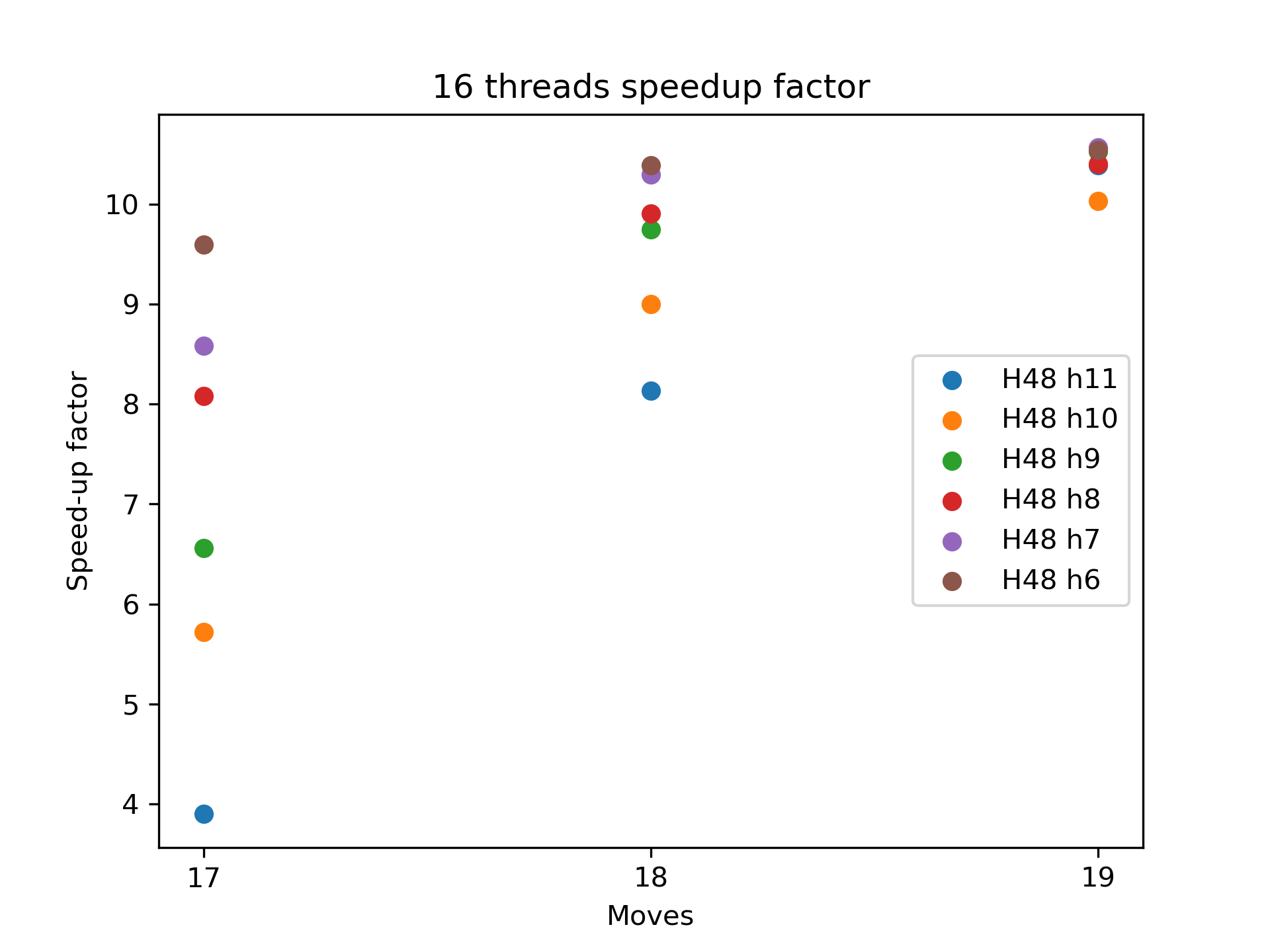
Speed-up factor (higher is better).
| Solver | Size |17 moves|18 moves|19 moves|20 moves|Superflip|
|:---------|:-------|-------:|-------:|-------:|-------:|--------:|
|H48 h11 |56.5 GiB| 3.90| 8.14| 10.39| 11.86| 8.45|
|H48 h10 |28.3 GiB| 5.72| 9.00| 10.03| 10.04| 9.09|
|H48 h9 |14.1 GiB| 6.56| 9.75| 10.53| | |
|H48 h8 | 7.1 GiB| 8.08| 9.91| 10.40| | |
|H48 h7 | 3.5 GiB| 8.59| 10.30| 10.57| | |
|H48 h6 | 1.8 GiB| 9.60| 10.39| 10.54| | |
Results: All solutions (16 threads)
Time per cube (in seconds, lower is better).
| Solver | Size |17 moves|18 moves|19 moves|20 moves|Superflip|
|:---------|:-------|-------:|-------:|-------:|-------:|--------:|
|H48 h11 |56.5 GiB| 0.04| 0.26| 2.22| 18.96| 16.95|
|H48 h10 |28.3 GiB| 0.05| 0.42| 3.82| 34.42| 36.80|
|H48 h9 |14.1 GiB| 0.08| 0.73| 7.28| | |
|H48 h8 | 7.1 GiB| 0.15| 1.56| 15.41| | |
|H48 h7 | 3.5 GiB| 0.21| 2.38| 26.52| | |
|H48 h6 | 1.8 GiB| 0.39| 4.67| 53.00| | |
Time per cube adjusted for table size (in seconds \* GiB, lower is better).
| Solver | Size |17 moves|18 moves|19 moves|20 moves|Superflip|
|:---------|:-------|-------:|-------:|-------:|-------:|--------:|
|H48 h11 |56.5 GiB| 2.11| 14.55| 125.21| 1071.23| 957.47|
|H48 h10 |28.3 GiB| 1.48| 11.96| 107.83| 972.35| 1039.73|
|H48 h9 |14.1 GiB| 1.08| 10.29| 102.88| | |
|H48 h8 | 7.1 GiB| 1.03| 10.99| 108.87| | |
|H48 h7 | 3.5 GiB| 0.74| 8.41| 93.69| | |
|H48 h6 | 1.8 GiB| 0.70| 8.25| 93.68| | |